


For years, return-to-work programs have focused on one central question: how do we help employees come back safely after an illness or injury?
A growing body of evidence is pushing accommodation and leave management professionals to ask an earlier question: did the employee need to leave work completely in the first place?
That distinction matters.
Work can provide structure, social connection, identity, and purpose during recovery. Research cited in this issue of @Work also shows that employees who go out on disability leave face significantly higher odds of developing new anxiety or depression than those who remain at work. At the same time, newer clinical guidance is encouraging healthcare providers to think not only about managing functional restrictions, but about preventing unnecessary workforce disengagement when continued participation in work is medically appropriate.
The implication for employers is significant: stay-at-work programs may deserve as much attention as return-to-work programs.
The “100% or nothing” mindset is increasingly hard to defend
One of the biggest barriers is cultural rather than clinical. In “Work Is Medicine,” Fred Schott describes the persistence of policies and practices that keep employees out until they are fully cleared, even when modified work may be possible. As he notes, the familiar “100% or nothing” standard is not grounded in the ADA and can work against individualized accommodation.
That same issue appears in temporary modified light duty programs. Rachel Shaw argues in this edition of @Work that temporary modified light duty can help employees maintain routine, income, and workplace connection while they recover. But the value depends on how the assignment is structured. Employers need to define the temporary role clearly, explain its purpose, and stay engaged as restrictions change.
The goal is not to keep everyone working at all costs. It is to avoid treating complete separation from work as the default when a safe, effective alternative exists.
More leave requests do not necessarily mean longer leaves
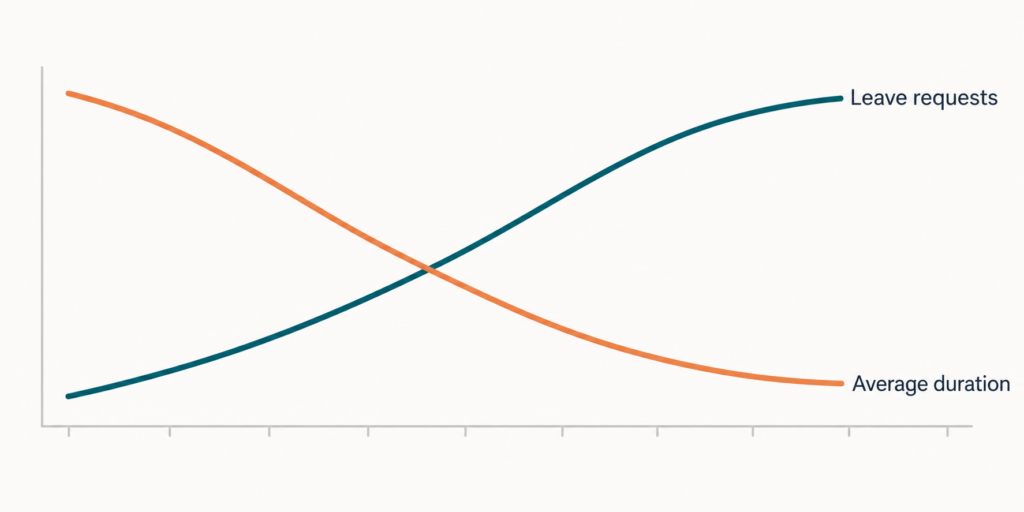
Gage Koeller and Kerri Wizner examined return-to-work durations across 29 million claims over a decade. Their analysis found that return-to-work durations generally decreased over time, even as employers reported an increase in leave requests.
The finding matters because recovery time is not determined by diagnosis alone. Healthcare access, workplace accommodations, job demands, flexible schedules, employee expectations, and broader social conditions all influence how quickly someone can return safely.
For accommodation and leave management professionals, that means duration should not be viewed only as a medical outcome. Workplace design and program decisions can shape it.
Managers are often where stay-at-work programs succeed or fail
Modified schedules and temporary assignments can create operational complexity. Coworkers may question why one employee has different equipment, hours, or duties. Managers may worry about workload, fairness, or productivity. Those concerns are real, but they are also manageable.
Schott argues that managers need better language for explaining accommodations without disclosing confidential information. Jess Dudley makes a related point in her article on empathetic return-to-work leadership: employees returning after illness or injury may be dealing with concerns about job security, reinjury, stigma, or financial pressure. Listening and clear communication matter alongside documentation and compliance.
The common thread is that effective stay-at-work and return-to-work programs cannot operate only through forms and policies. Managers need the skills to carry them out in practice.
Accommodation and leave management is moving upstream
The trend here is larger than any single stay-at-work program. Accommodation and leave management has traditionally invested significant effort in managing what happens once an employee goes out on leave: certification, duration, benefits, communication, and return.
Those functions remain essential. But this issue of @Work points toward an earlier intervention point.
Could an accommodation keep the employee working safely? Could temporary modified duty preserve connection during recovery? Could a flexible schedule prevent a full absence? Could better manager training help an employee raise a need before work becomes unsustainable?
Those questions do not eliminate leave. There will always be circumstances where time away from work is clinically necessary and appropriate.
But when work can safely remain part of recovery, treating leave as the automatic first step may create unnecessary distance between the employee and the workplace.
For accommodation and leave management professionals, the opportunity is to build programs that can distinguish between those situations and respond accordingly.
The best return-to-work strategy may sometimes begin before an employee ever leaves.